University Policies on Reducing Plastic Use
- Plastic Reduction Policy at the University of Oum El Bouaghi
- Introduction
The University of Oum El Bouaghi is committed to complying with environmental laws and procedures, and it emphasizes the importance of environmental protection and the mitigation of environmental and health impacts of plastic usage. This policy aims to reduce plastic usage at the University of Oum El Bouaghi; it encourages the use of eco-friendly alternative materials.
- General Principle
- Compliance with the Law: The University adheres to national laws and procedures related to reducing plastic usage.
- Awareness-Raising: The University draws its members’ attention to the hazards of plastic materials and raises their awareness of the importance of substituting them with eco-friendly alternatives.
- Sustainability Promotion: The University encourages taking measures to achieve sustainability in plastic usage and disposal.
- Practices
- Using Eco-Friendly Alternative Materials: Instead of using the plastic products, the University commits utilizes eco-friendly alternative materials its activities and operations.
- Reducing Consumption: The University encourages reducing plastic usage through reducing personal consumption and encouraging reuse.
- Enhancing Recycling: The University encourages effective plastic recycling and provides suitable collection methods.
- Training Provision: The University trains its members to enhance their understanding of the importance of reducing plastic usage and endorsing best practices.
- Responsibility
- Compliance Reports: The University commits to regularly submit reports on its plastic reduction practices and compliance with the laws to the Ministry of Environment and Renewable Energies, the National Waste Agency, and the Ministry of Trade.
- Implementation:
This policy is an integral part of the practices of Oum El Bouaghi University, and all its members are obliged to adopt it and comply with it. The university collaborates with governmental bodies and relevant organizations to achieve the specified goals.
- Sources:
- Ministry of Environment and Renewable Energies: https://www.me.gov.dz/fr/reglementation/dechets/
- National Waste Agency: https://and.dz/
- Ministry of Trade: https://www.commerce.gov.dz/reglementation/recueil/-99?page=1
- Algerian Organization for Consumer and Environment Protection (APOCE): https://apoce.org/
- Laws on Plastic Reduction
Plastic Waste Laws – National Waste Agency
Executive Decree No. 02-372, issued on November 11, 2002, related to packaging waste.
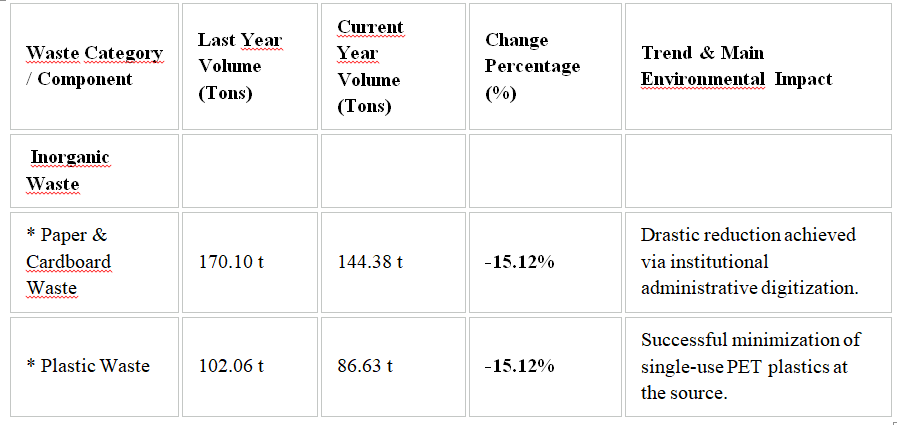
Description:
Institutional Analytical Report & Description
1. Current Metrics & Baseline Context
Inorganic, non-biodegradable waste streams historically represent a significant challenge for higher education institutions regarding visual littering, spatial landfill volume, and long-term carbon liabilities. At the University of Larbi Ben M’hidi – Oum El Bouaghi, this matrix is strictly audited and segmented into two main macro-categories:
- Paper and Cardboard Waste: Originating directly from core academic and administrative functions, including financial departments, centralized registries, exam booklets, and faculty printing facilities.
- Plastic Waste: Predominantly taking the form of single-use Polyethylene Terephthalate (PET) water bottles, plastic cups, and post-consumer polymer packaging discarded across student residential complexes, recreational zones, and campus cafeterias.
2. Quantitative Assessment of the Strategic Decrease (-15.12%)
The verified data from the current annual evaluation cycle reflects a highly powerful, synchronized downward trend in the university’s absolute inorganic footprint. Annual paper and cardboard waste plummeted from 170.10 tons last year to 144.38 tons this year. Concurrently, annual plastic waste generation was successfully suppressed from 102.06 tons down to 86.63 tons. This dual contraction establishes an exact 15.12% absolute reduction across the university’s monitored inorganic recyclable footprint, demonstrating high-efficiency source suppression.
3. Technical Action Blueprint & Structural Interventions (HOW)
This definitive decoupling of institutional expansion from waste generation was accomplished through aggressive administrative reforms and target-driven infrastructure deployment:
- Institutional Digitization Master Plan: The dramatic decline in cellulose fiber consumption is directly attributed to migrating traditional paper-based workflows over to cloud-based academic management architectures. Most notably, through the comprehensive optimization of the Progrès digital platform, the university successfully virtualized student registrations, academic grading matrices, human resource documentation, and inter-departmental communications, saving thousands of physical reams of paper.
- Polymer Minimization & Infrastructure Pivots: To combat plastic accumulation, the university administration implemented a strict ban on single-use plastic cups across staff offices and partnered with student associations to launch targeted behavioral campaigns. This structural shift was reinforced by installing high-capacity, filtered drinking water fountains across major faculties, encouraging thousands of students to transition toward reusable aluminum or BPA-free personal water flasks.
4. Environmental Motivation & Ecosystem Safeguarding (WHY)
The primary driving force behind this 15.12% source reduction bridges resource conservation with regional environmental protection:
- Deforestation & Industrial Water Savings: Reducing paper waste directly cuts the university’s indirect pressure on global wood pulp demands, conserving vast forest ecosystems, and saving immense amounts of industrial water and electrical energy required for virgin paper manufacturing.
- Microplastic Contamination Blockade: Plastic waste represents an eco-toxicological threat due to its non-biodegradable nature and its tendency to fragment into dangerous microplastics. Restricting this polymer stream at the source prevents persistent plastics from leaching into local soils and regional waterways, drastically lessens municipal waste hauling overheads, and reinforces a visible, campus-wide culture of sustainable consumption.