University Policy on Waste Measurement and Recycling
- Waste Disposal Policy at the University of Oum El Bouaghi
- Introduction
The policy cites Law No. 01-19 of 12 December 2001, which establishes the national framework for waste management, control, and disposal.
- General Principles
- Waste operations are conducted in accordance with applicable national waste-management law and procedures.
- Measurement and reporting should distinguish waste streams, including organic, inorganic, and hazardous materials.
- Storage and transfer arrangements should protect health and the environment and maintain traceable records.
- Practices
- Waste should be stored safely pending collection, treatment, recovery, or disposal.
- Hazardous materials require additional precautions, suitable packaging, and controlled handling.
- Waste-management procedures should specify responsibilities and appropriate routes for recovery or disposal.
- Responsibilities
- Awareness and instructions help staff and students separate waste and follow applicable handling requirements.
- Periodic reporting supports review of waste quantities and the performance of management measures.
- Implementation
The policy is implemented through the responsible university services and applicable procedures.
- Sources:
- Ministry of Environment and Renewable Energies:https://www.me.gov.dz/fr/reglementation/dechets/
- National Waste Agency: https://and.dz/site/wp-content/uploads/Rapport%20RND%20Arabe.pdf
Law No. 01-19 issued on December 12, 2001
- Agreement with the Directorate of Environment – Oum El Bouaghi: http://www.univ-oeb.dz/vrlex/wp-content/uploads/2018/11/Conventions-Partenariat-socio-economique/Convention-direction-de-lenvironnement.pdf
- Waste Recycling Policy at the University of Oum El Bouaghi
- Introduction
The university’s recycling policy sets out an institutional commitment to prevent waste and recover suitable materials where feasible.
- General Principles
- Recycling activities must comply with national requirements and applicable technical standards.
- The university encourages responsible separation and recovery of recyclable materials.
- Practices:
- Suitable collection and separation arrangements should support the recovery of paper, cardboard, plastics, and other accepted materials.
- Hazardous waste must follow the separate regulated handling and treatment route applicable to that stream.
- Waste prevention, reuse, and responsible consumption complement recycling measures.
- Responsibilities
- Awareness activities support correct separation and reduce contamination of recyclable streams.
- Records of collected and transferred materials support reporting and performance review.
- Implementation
The policy is implemented by the relevant university services in coordination with applicable partners.
- Sources:
- Ministry of Environment and Renewable Energies: https://www.me.gov.dz/fr/reglementation/dechets/
- National Waste Agency: https://and.dz/site/wp-content/uploads/Rapport%20RND%20Arabe.pdf
- Agreement with the Directorate of Environment – Oum El Bouaghi: http://www.univ-oeb.dz/vrlex/wp-content/uploads/2018/11/Conventions-Partenariat-socio-economique/Convention-direction-de-lenvironnement.pdf
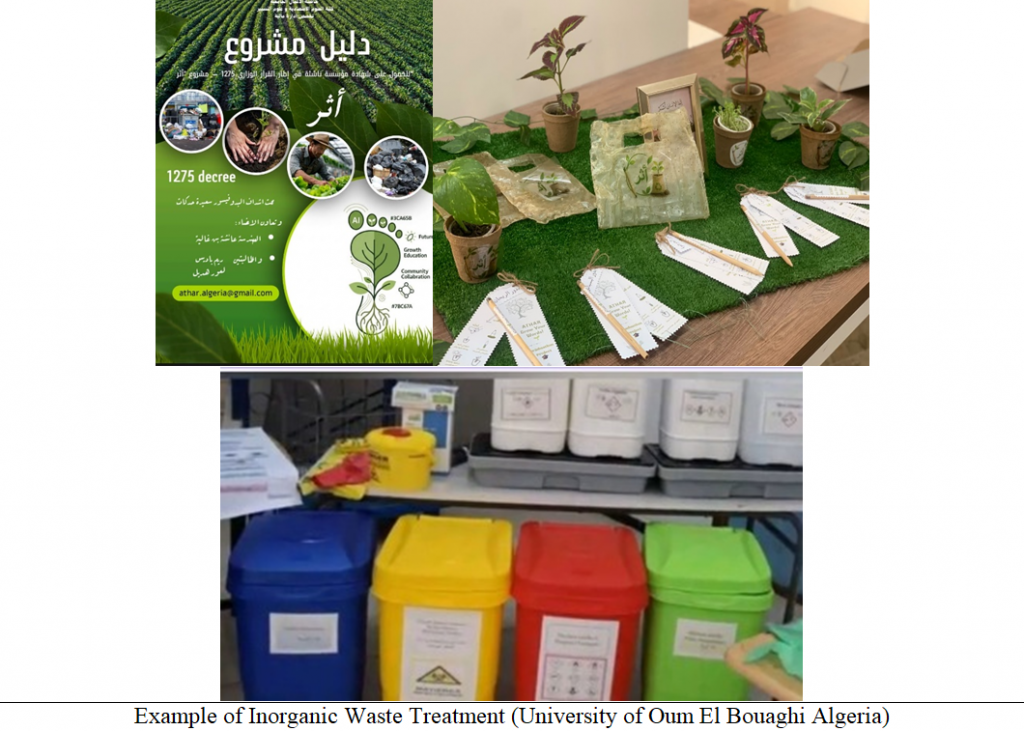
Throughout the evaluated academic year, the solid waste inventory auditing at the University of Larbi Ben M’hidi – Oum El Bouaghi (UNIV-OEB) recorded a cumulative volume of 231.01 metric tons of inorganic, non-biodegradable recyclable materials. This complex inorganic stream is characterized by two predominant high-volume sub-components:
- Paper and Cardboard Waste (144.38 tons): Heavily generated by core academic and administrative functions, including the centralized printing of administrative records, exam booklets, institutional registries, and faculty documentation.
- Plastic Waste (86.63 tons): Primarily comprising Polyethylene Terephthalate (PET) beverage bottles and post-consumer food wrappers generated across student dormitories, retail kiosks, residential catering blocks, and campus recreational zones.
2. Quantitative Mitigation Efficiency & Recovery Architecture (60.00%)
In strict alignment with international sustainable campus principles and circular economic models, UNIV-OEB deployed an aggressive, structural source-separation strategy across all institutional faculties and student residential complexes. This targeted infrastructure intervention led to the successful physical recovery and diversion of 138.61 metric tons of clean, un-contaminated recyclables away from municipal dump networks. This mathematically validates a highly efficient 60.00% absolute inorganic waste treatment and recovery rate, proving a significant reduction in the university’s environmental liabilities.
3. Operational Methodology & Industrial Value Chain Partnerships
The execution of this recycling framework relies heavily on institutional behavioral engineering and formalized external economic partnerships:
- Color-Coded Source-Separation Infrastructure: Dual-stream recycling infrastructure—specifically blue bins for cellulose-based fibers and yellow bins for rigid polymers—was strategically established at high-traffic hubs, administrative reception blocks, and main student squares to optimize sorting at the point of disposal.
- Cellulose Fiber Circular Loop: Collected paper waste is dynamically consolidated, baled, and transferred to local pulping and cardboard manufacturing entities to be remanufactured into secondary commercial packaging solutions.
- Polymer Mechanical Processing: Concurrently, PET plastic waste is systematically isolated, flattened to optimize logistics and transit volume, and routed to licensed regional plastic recycling enterprises. Here, the material undergoes advanced industrial mechanical processing, including automated hot washing, grinding into clean flakes, and extrusion into high-grade recycled polymer pellets.
4. Environmental Motivation & Ecosystem Preservation Impact
Achieving a 60.00% recovery rate for inorganic materials is an essential baseline metric within the university’s Environmental Mitigation and Carbon Abatement Plan. Viewed through a lifecycle analysis (LCA) lens, this program achieves profound ecological milestones:
- Deforestation & Resource Mitigation: Recycling 60% of paper fibers dramatically curbs the university’s indirect impact on global deforestation, conserving immense amounts of water and electrical energy that would otherwise be consumed in processing virgin timber.
- Microplastic & Soil Protection: Intercepting PET polymers directly protects the local subsoil, regional drainage networks, and terrestrial ecosystems from persistent plastic littering, avoiding the progressive solar fragmentation of plastics into hazardous microplastics.
- Visible Pedagogical Tool: Beyond the quantitative data, this active circular ecosystem serves as a practical, highly visible pedagogical asset, successfully embedding the concepts of the circular economy and environmental stewardship directly into the daily operational habits of the university community.